By Rebecca Thompson for ELCR
While horses may no longer play the everyday roles they once did in human society, their capacity to positively impact individuals and communities remains significant. One such area is equine-assisted therapy, a practice that has existed for centuries. However, it was not until the 1990s that equine-assisted psychotherapy (EAP) gained broader public recognition. Since then, growing research has continued to demonstrate the therapeutic value of human–horse interactions, particularly within the field of mental health.
Equine-assisted psychotherapy is a form of experiential therapy that incorporates horses into mental health treatment. During EAP sessions, a licensed mental health professional collaborates with an equine specialist to facilitate therapeutic activities. This interdisciplinary approach has been used to support individuals experiencing a range of conditions, including ADHD, autism, anxiety, depression, substance misuse, and other mental health challenges.
A related article published by ELCR, Horses Healing Humans: The Multifaceted Role of Equines in Addiction Rehabilitation, highlights several programs across the United States where equine-assisted therapy is being successfully used to support individuals affected by addiction on their journey toward recovery. This article focuses on Christian faith-based organizations in Northwest Arkansas that are using equine-assisted programs to guide at-risk teenagers toward becoming responsible, healthy adults.
| Northwest Arkansas is blessed to have three — and soon four — Christian faith-based organizations that guide at-risk teenagers in becoming responsible adults, all with the help of horses. |
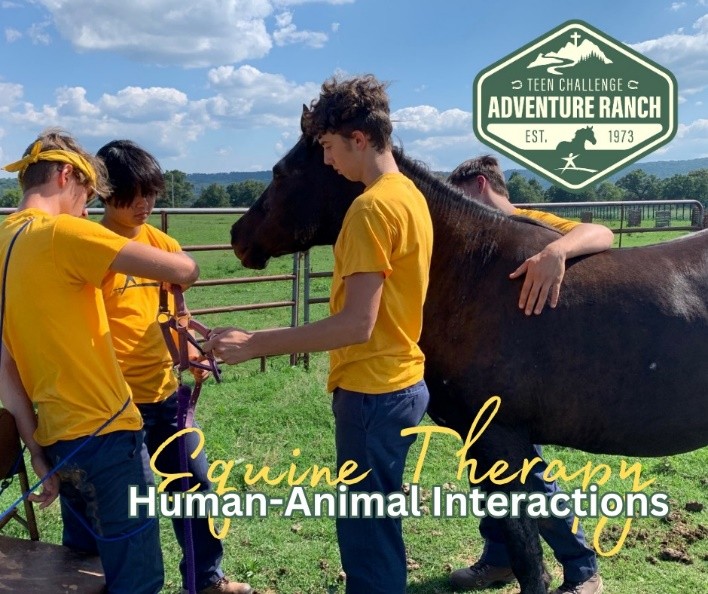
In the 1970s, John and Nelda Nevels opened their home in Morrow, Arkansas, to troubled boys in need of guidance and care. What began as a personal, Christ-centered outreach known as the King’s Ranch grew into something much larger. In 1973, the ministry became officially affiliated with Teen Challenge USA, establishing the first residential Teen Challenge program dedicated exclusively to adolescent boys struggling with addiction and behavioral issues.
Since its founding, Teen Challenge Adventure Ranch (TCAR) has helped thousands of young men overcome substance abuse, mental health challenges, and destructive behavioral patterns. With more than 50 years of experience and over 2,000 families served, the program has become a trusted source of hope for families navigating some of the most difficult challenges of adolescence.
Nestled on a 31-acre campus in the scenic Arkansas Ozarks, the ranch is set in a tranquil valley surrounded by sweeping mountain views—an environment well suited for healing and personal transformation. This natural setting complements TCAR’s holistic approach, which integrates outdoor adventure and equine-assisted therapy with evidence-based clinical care, all grounded in a Christ-centered framework.
At the heart of the campus is the Full-Life Center, a multi-purpose facility that provides therapeutic services, academic support, and recreational opportunities. Additional amenities include two residential dormitories, a recreation building, and a fully equipped equestrian center.
Equine-assisted therapy plays a central role in the healing process at TCAR. Through working with horses, teens develop self-awareness, strengthen non-verbal communication skills, and begin to rebuild trust. For many participants, these experiences are both new and deeply transformative. Guided by trained therapists and supported by natural horsemanship techniques, equine-assisted psychotherapy at TCAR offers powerful, hands-on opportunities for lasting emotional and behavioral growth.Top of FormBottom of Form
Through a holistic, faith-based approach, TCAR continues to transform lives and restore hope for teens and families across the country. TCAR’s leadership now plans to open Genesis Ranch, a similar residential program for teenage girls. To that end, the Ranch seeks to raise $1 million in start-up costs, including the purchase of a nearby property in Cane Hill, Arkansas.
TCAR therefore sought advice and support from Saving Grace in Centerton, Arkansas, a transitional program with equine therapy for young women..

Saving Grace offers hope and transformation to young women ages 18-25 who are aging out of foster care or facing homelessness. That transformation comes through relationships, coaching, and opportunities that empower generational change. Saving Grace provides safe housing in a dorm-style setting and offers each young woman educational assistance, career guidance, coaching, counseling, and more. Young women in their program are taught essential life skills like money and time management, cooking and meal planning, relationship skills, and car care. They receive personalized coaching to support them in achieving important life goals, including getting a driver’s license, securing a job, buying a car, continuing their education, starting a savings account, and more.
In 2025, representatives from Saving Grace and the Northwest Arkansas Equine Coalition (NWAEC) met at Teen Challenge Adventure Ranch for a shared lunch, a guided tour of the facility, and a presentation outlining plans for Genesis Ranch. During the visit, members of Saving Grace and NWAEC offered valuable insight on fundraising strategies, best practices for supporting girls in residential programs, and ways to promote Genesis Ranch through social media. They also emphasized the importance of grouping girls in even numbers within dormitories and small-group settings to help foster strong friendships and avoid feelings of isolation.
Additional recommendations included providing young participants with not only nurturing experiences—such as caring for and bonding with horses—but also opportunities to engage in challenging, skill-building, and competitive activities. These experiences were encouraged as a way to build confidence, instill a sense of accomplishment, and allow girls to take pride in achieving goals comparable to those offered in boys’ programs. Drawing from their own experience, Saving Grace representatives also shared practical guidance on hosting successful benefit dinners, galas, and online TCAR and future Executive Director of Genesis Ranch, shared that Genesis will follow the same faith-driven, clinically based model that has produced a 78 percent long-term success rate among TCAR’s young male graduates. Genesis Ranch and TCAR will operate under the same Board of Directors, and the young women enrolled at Genesis will have access to TCAR’s equines and stables during times when the boys are engaged in other activities.
Thomas also noted that Genesis Ranch is in the process of securing a permanent home. A suitable property on sufficient acreage has been identified nearby, and Genesis has already raised significant funds toward its purchase.
Another program based in Fayetteville, Boston Mountain Youth Ranch, provides a free, outdoor youth mentoring program designed to support children facing trauma, poverty, grief, and other challenging life circumstances in Northwest Arkansas. Through hands-on mentoring alongside a herd of horses, children build positive relationship skills using movement, playfulness, and non-judgmental connection. These experiences help children process emotions, develop resilience, and gain new perspectives on themselves and the world around them.
Rooted in a mission to offer a safe, structured, and loving environment, the Ranch invites children and families into a supportive community grounded in God’s unconditional love. By fostering curiosity, spiritual growth, and authentic relationships, Boston Mountain Youth Ranch seeks to guide children toward wholeness with God, themselves, and others—ensuring all families can participate at no cost
Northwest Arkansas is fortunate to be home to programs such as TCAR, Saving Grace, Boston Mountain Youth Ranch, and the forthcoming Genesis Ranch. Together, these organizations exemplify the enduring value of the human–horse partnership and underscore the importance of advocating for horses within our communities, particularly as local landscapes continue to evolve. To learn more ways horses benefit our communities, go to Ben
Related topics
 Maryland Horse Farms for Healthy Horses and a Clean Environment
 Utilities and Recreational Trails: A Summary of the Article “Trails and Utilities: A Powerful Partnership” by the Rails to Trails Conservancy
 Equestrian Trails Webinar Recording: “Barn to Trail – Managing Sustainability on Equine Properties”
 What Equestrians Need to Know About the USDA 10-Year Trail Shared Stewardship Challenge