Executive Summary
The Equine Land Conservation Resource (ELCR) enters FY2026–FY2028 during a period of significant land-use change affecting equestrian communities across the United States. Data from the United States Department of Agriculture Census of Agriculture shows the United States lost approximately twenty million acres of farmland between 2017 and 2022, continuing a long-term trend of agricultural land conversion to residential, commercial, and infrastructure development. Since the 1960s, the country has lost more than 230 million acres of farmland averaging 2,000 acres per day.
These changes affect equestrian communities directly. As farmland and open space decline, horse farms, trails, and equine facilities face increasing development pressure, higher land values, and shifting land-use priorities. Population movement from urban to rural areas since the COVID-19 pandemic has further accelerated property value increases in many regions. Rising land prices and changing community expectations can make it more difficult to maintain equine operations and preserve land for horse-related activities.
In addition, the expansion of large-scale infrastructure such as high-voltage transmission lines and energy-intensive data and AI processing centers presents new challenges. These developments can fragment open land, disrupt trail connectivity, alter scenic landscapes, and introduce noise and environmental concerns that are incompatible with equine use, further threatening the long-term viability of horse farms and related activities.
ELCR is the only national nonprofit organization dedicated exclusively to equine land conservation. Its work supports communities seeking to protect horse farms, trails, and open space through education, technical assistance, and advocacy.
This strategic plan reflects input from ELCR board members, donors, conservation professionals, and industry stakeholders. It outlines priorities for strengthening organizational capacity, improving governance, expanding programs, and increasing advocacy to address land-use challenges affecting equestrian communities.
Strategic Focus Areas
Building Organizational Capacity
ELCR will strengthen internal systems and staffing to support program growth and financial sustainability. Planned actions include hiring a Marketing & Development Director and a Technical Program Director, launching a new integrated website and fundraising database, and developing a multi-year fundraising strategy to expand and diversify revenue.
The website upgrade will transform ELCR’s site into a modern, engaging platform that elevates its role as a trusted resource for equine land conservation while strengthening donor acquisition and retention. The new site will serve as a central resource hub for equine land conservation combining compelling storytelling with streamlined fundraising tools, an easy-to-manage CMS, and integrated systems to improve usability, access to educational resources, visibility, and overall impact.
Strengthening Governance and Leadership
The organization will expand and diversify its board of directors, restructure the Advisory Council, and update governance practices to support long-term strategic priorities and national engagement.
Expanding Programmatic Impact
ELCR will evaluate its existing programs to ensure they deliver measurable outcomes for communities working to conserve and protect access to land for equine-related use. Based on this assessment, the organization will develop and pilot an enhanced service model focused on technical assistance, land-use planning education, zoning guidance, and support for local equine advocacy efforts.
Elevating Advocacy and National Influence
Land-use decisions that impact equine lands are typically made at the local and regional levels. To better support these efforts, Equine Land Conservation Resource will expand its advocacy capacity by developing a comprehensive online advocacy toolkit, strengthening partnerships with conservation and industry organizations, and raising awareness of the economic and community benefits of equestrian land use.
This work will also focus on equipping local advocates with practical tools—such as guidance on engaging in zoning and planning processes, templates for communicating with decision-makers, and strategies for building coalitions—to ensure that the needs of the equestrian community are effectively represented. By empowering horse owners, land managers, and supporters to participate confidently in local decision-making, ELCR aims to help safeguard equine lands and promote sustainable, horse-friendly communities.
Implementation and Partnership
The FY2026–FY2028 strategic plan provides a framework for strengthening ELCR’s role as a national resource for equine land conservation. Through expanded partnerships, improved tools, and targeted programs, ELCR will support communities working to protect land for horses and equestrian use and maintain the economic, environmental, and cultural benefits those lands provide.
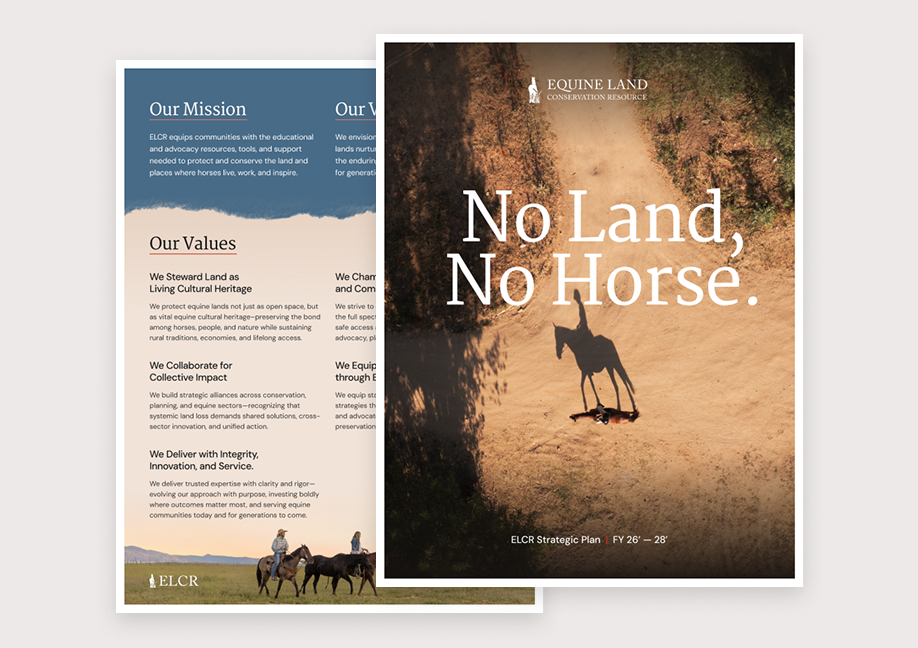
View the complete ELCR FY2026-FY2028 Strategic Plan Document